Chapter 1·Introduction
The Speed Run
This chapter is the entire guide at tactical speed: the basic timeline of a raise, stripped of theory, with pointers into the chapters where each move is explained in depth. Use it two ways. Read it now, start to finish, to see the whole shape of what's coming. Then come back to it during your raise as an executable table of contents, jumping to whichever chapter the current week demands.
Each stage takes a different amount of time. Some require intense bursts of work; others are small efforts spread across months. The one non-negotiable is starting before your runway forces you to do so. You should aim to complete your raise before you hit six months of remaining cash, because the active part of a fundraise takes anywhere from two weeks to three months and you cannot afford to run out of clock mid-process. Best practice is to start this timeline twelve months ahead of your cash-out date, which leaves a few months for groundwork and enough room to run the process without the smell of desperation, which investors detect at extraordinary range.
Remember that thinking you deserve money has nothing to do with getting it. Raising a priced round is genuinely hard. For example, roughly a third of seed-funded companies go on to successfully raise a Series A and only a third of those will then raise a Series B. The work below is how you end up on the right side of that ratio.
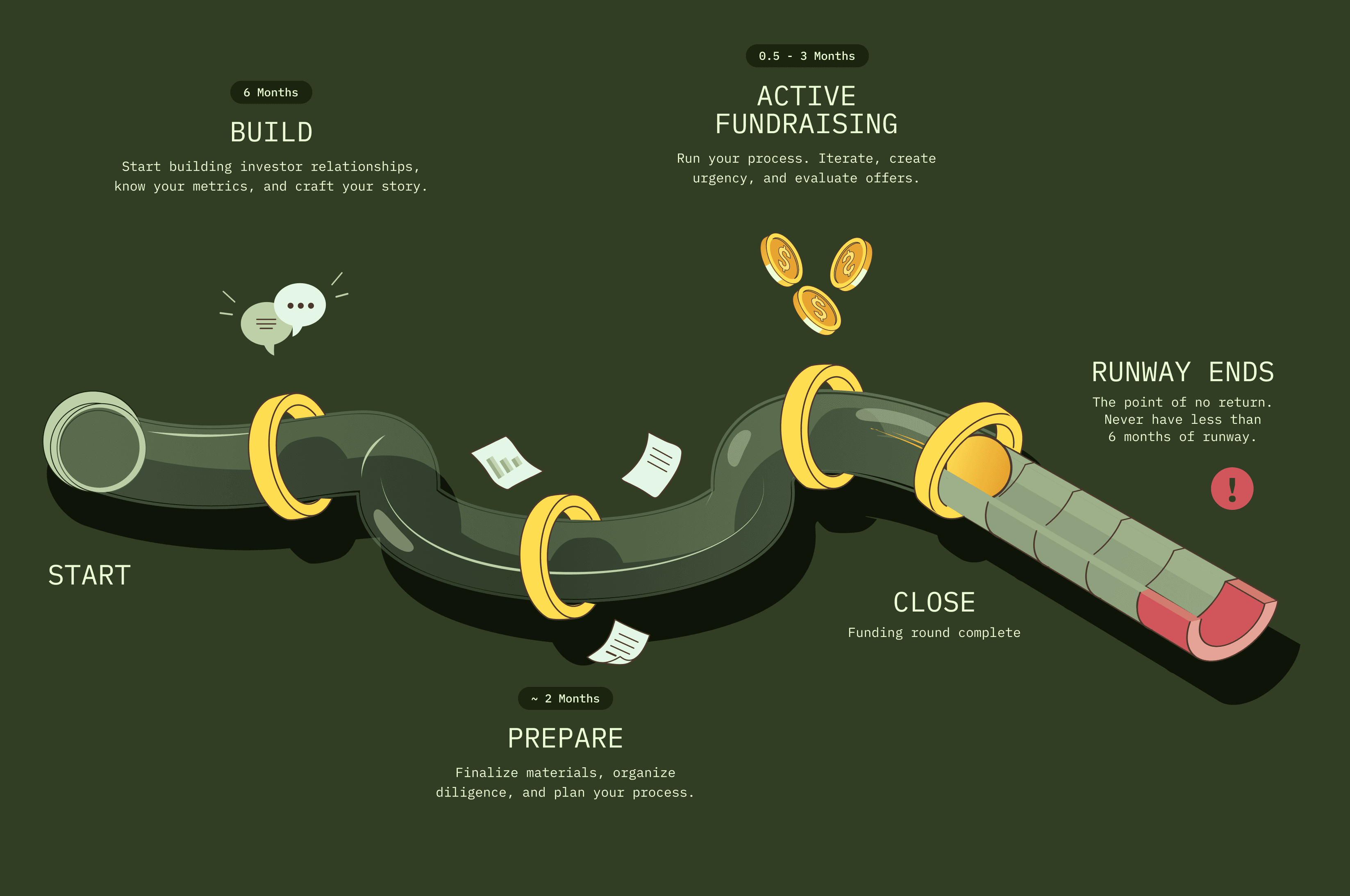
6 to 12 months before the raise
Introspect. Before you start on any fundraising prep, ask yourself: is capital genuinely the limit - or soon to be the limit - on your growth? If the honest answer is no, stop here and go back to building.
Know your metrics. There's no specific number that gets you funded, but that's no excuse for not knowing your own. Metrics serve as a shortcut that investors use to gauge how well you understand your own business, and by extension how much to trust you. But the number you hit matters less than the consistency and intensity with which you grow since investors are hunting momentum, not precise milestones.
Draft the story. Before you talk to any investor, identify the three or four most important things about your business from an investor's perspective. These are not the things you do day to day; they're the things that will make the company huge. Then leverage your early coffee meetings with investors as a laboratory to test different versions, watch what resonates, and refine.
Build investor relationships. Make a list of investors who lead rounds like yours, and figure out how to meet them through warm introductions. Start meeting them for ‘coffee’ to learn who you'd actually want to work with. These meetings are a balancing act since you want to be impressive enough to excite, but guarded enough that nobody can reach a decision. Track everything in the Venture Codex FRM or a similar system.
Know what pre-emption looks like. An investor with an existing relationship may deliver a term sheet before you ever start a process. A real pre-emptive offer is a written term sheet; anything less is an attempt to start a one-on-one process on the investor's timeline. If paper actually arrives, there's a decision tree waiting for you.
2 months before the process
Set the amount. Target the minimum you need to hit the milestones for your next round. This will often be metric based, in which case think 5x your current numbers plus a buffer. If your progress is meant to be measured on a technical level, figure out what will be an order of magnitude more impressive than what you have now. Build a model covering roughly two years of spend to find the number, and pick a number, not a range.
Write a Plan B. Write down what you’ll do if the raise fails: profitability on remaining capital, or a bridge sized to reach profitability or a genuine step change. Fundraising is emotionally brutal, and a written fallback is a cushion for the hardest days.
Build the materials. Take the story notes from your coffee meetings, think hard about how the business has grown since your last round, and organize it all into a deck and a memo. These should walk through your progress, your strengths, and the path to building a generational company. Pick a small set of advisors who've seen many raises succeed and fail and who’s primary motivation isn’t to own more of your company. Use them as a brain trust to solicit feedback without shopping for the feedback you want.
Practice the pitch. An investment pitch is an interactive performance. Rehearse until it flows, and until you can field objections without wobbling.
1 month before the process
Free your schedule. Delegate your operating tasks for the coming month since the raise will take everything you have. Finalize any pending hiring offers so equity is granted at pre-round prices.
Coordinate your current investors. Helpful insiders can identify the right partners, make warm introductions, back-channel your diligence, and keep you sane. If an insider could have led but won't, agree on the narrative together before the market starts asking.
Run the pro-rata inventory. Organize the cap table and figure out how much of the round is already spoken for once pro-ratas are exercised, and what your dilution actually looks like.
Assemble the diligence pack. P&L, forecast, cap table, in a tracked data room, ready to send. Preparing for this early helps you control the narrative and reduces your mid-process workload.
Schedule pitches in cohorts. Group meetings tightly by stage. Pack initial pitches inside one to two weeks with (ideally) partnership meetings coming after. This enables offers to land nearly simultaneously without investors discovering who passed. Creating this type of auction is your greatest point of leverage.
Prepare for post-term-sheet diligence. Gather everything on the legal diligence checklist into a data room now so you save valuable time at closing.
During the raise
Pitch, and iterate daily. Set aside time every day to review what generated skepticism and what generated heat. Crunch the data, add appendix slides for recurring questions, and keep sharpening the story toward what's landing.
Create urgency, honestly. Give each investor enough process information to keep them moving. Interested investors follow up within 24 to 48 hours, but if they don't you can nudge while appearing busy rather than desperate. And when materially good news happens mid-raise (e.g. a big contract closes), tell everyone immediately. Real momentum is the one pressure that never backfires.
Share information deliberately. Confidential information is a currency. When a request arrives, ask what question the investor is trying to answer. While most everyone will seem interested initially, only roughly a quarter truly are. Your job is telling the difference and spending your time accordingly.
Repeat as needed. If everyone passes or goes quiet and you're determined to continue, then get a new list, new introductions, new meetings. There is no upper limit on investors pitched, only on disorganized processes.
When a term sheet arrives
Understand the terms. Work out how terms and conditions interact to create long-run consequences, especially around control.
Notify the investors who are deep in your process. Verbal promises don't count as term sheets, and don't disclose whose paper you're holding. Use a term sheet to accelerate other investors only if you'd genuinely sign it.
Choose the partner, not the price. With multiple offers, diligence the investors the way you'd diligence a cofounder. You should meet them socially, but also get references from founders they backed whose companies succeeded and struggled.
Closing
Get the money in the bank. Confirmatory diligence, definitive documents, SAFE-holder signatures, and the post-closing checklist: new 409A, board cadence, filings and announcement timing, insurance. A signed term sheet is not a closed round.
Consider venture debt. If you want it, the moment your round closes is the moment of maximum leverage and maximum facility size. Understand the clauses that can kill you before you sign anything.
There you go, a successful fundraise! Now we’ll go into the details.