Chapter 8·Part II, Preparing to Raise
Building Relationships
Long before you formally raise, you should be engaging with investors. You want to impress investors enough that they lean in without divulging so much that they can fully evaluate your company and quietly decide. The purpose is to work through a list of potential leads and identify the ones with whom you'd genuinely want to work.
Don't mistake these meetings for full on fundraising. Successful founders actively decide when to raise, communicate that decision clearly, and run structured processes. Pre-raise relationship building is what makes the eventual process fast and competitive since it ensures that when you do start fundraising your market is made up of high-quality investors who already want to be there. Think of it as tilting the market in your favor before the auction opens.
Building these relationships is more important in the AI era than ever before. Without being able to rely on traditional metrics or signals of company progress, investors are leaning more heavily on relationships and intuition to guide decisions. Without a proper network of relationships it is significantly harder to raise a substantial priced round. Conversely, founders with strong, excited VC relationships are most likely to receive pre-emptive offers and raise mega-rounds.
Forging those relationships isn’t magic. Here's how to do it.
Build the list
First, understand what you're up against. Ask a founder to name the funds that could lead their round and you'll get maybe fifteen or twenty funds with no partner-level detail. Meanwhile, we looked at the Venture Codex’s dataset of every Series A in the US, EU, Canada, and Israel from 2023 through September 2026. We counted over 4,700 rounds, led by roughly 2,400 different funds. Twenty four hundred. Fundraising has a massive discovery problem, so founders who treat list-building as real research have a real advantage.
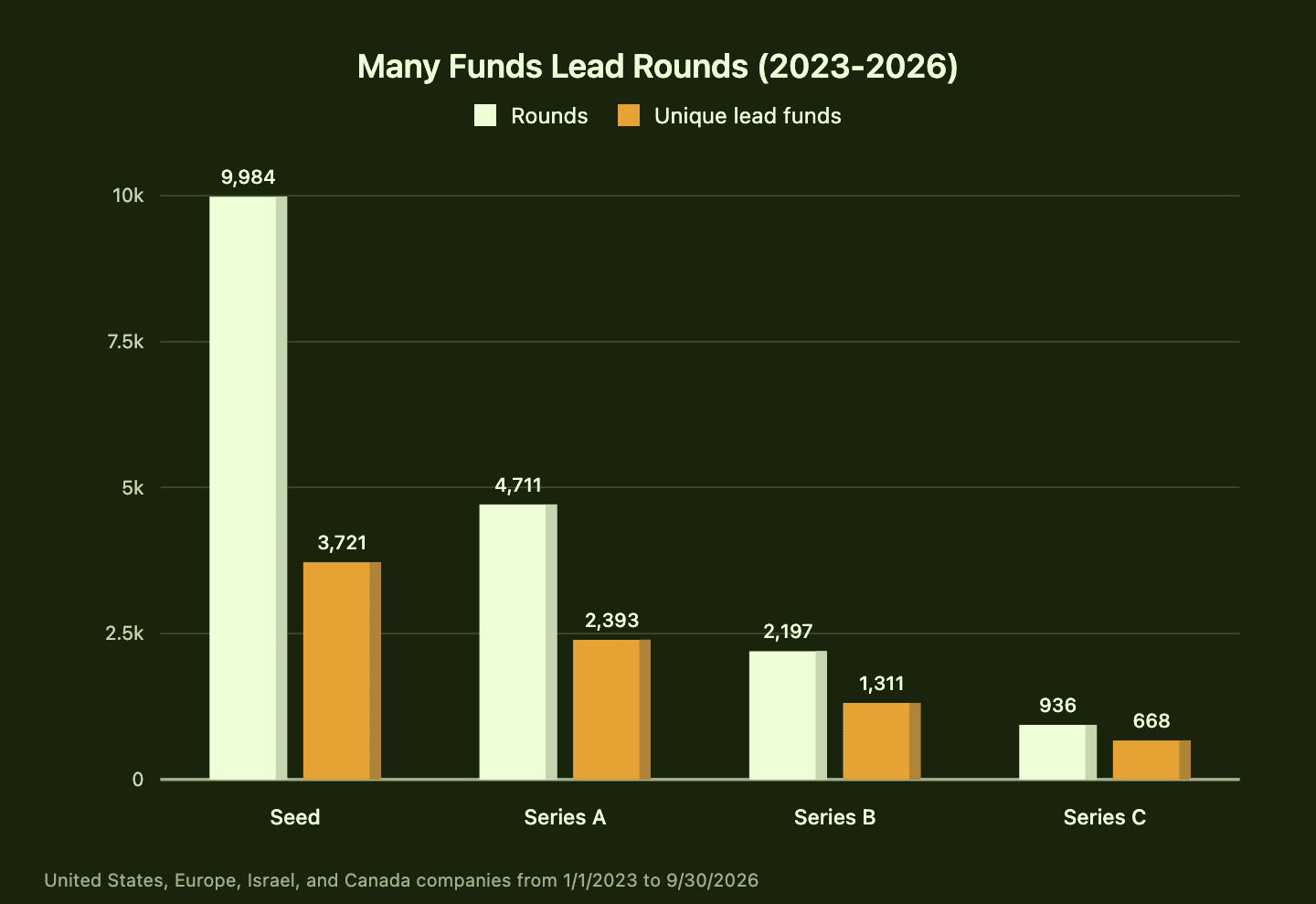
Your job is to figure out which investors actually lead rounds at your stage, in your space, at the size you want, and which of them you might want to work with. Look for investors who:
You've had positive interactions with, or know personally
Have written or spoken seriously about your industry
Have led rounds in your niche (watching carefully for competitive portfolio conflicts)
Optimize for partner quality over firm logo. There is a fetishization in the venture world of “Tier 1” funds like Sequoia Capital, Andreessen Horowitz, and General Catalyst who have funded some of the most iconic startups of the last two decades. But blindly gunning for prestigious names is often a poor strategy. Instead consult founders in your space about who actually helps versus who merely wires money, and read what investors write to understand what they care about.
One thing to verify early is whether the person you're talking to can actually write the check you want. Decision-makers usually carry titles like “General Partner” or “Managing Director.” They sit on boards and write publicly about their investments. There’s nuance here, and pitching non-decision-makers is one of the most common ways founders waste months of time. When in doubt, you can ask directly. Good investors respect the question.
Finally, treat this process like a sales funnel and track it in a system like the Venture FRM. There you can also search through a comprehensive list of venture funds and review past investment data to ensure they are relevant for you.

Get warm introductions
For every investor on your list, map out an introduction path for someone to get you in front of that investor. This is most often someone who will forward an email or text an investor about your startup.
The person who introduces you matters because investors make initial evaluations of opportunities through the credibility of that person. Avoid the connectors who introduce everyone to everyone since their introductions carry no signal. From an investor's perspective, the best introductions come from, in descending order:
Someone who has made them a lot of money (e.g a successful founder they backed)
A strong portfolio company of theirs that is your customer
One of your existing investors, reputable but clearly unable to lead this round
A trusted friend
Founders are the best and most underused source. They remember what it was like, and it never hurts to ask.
Script the introduction. Angels love to help but their unscripted help sounds like: "You have to meet this company, they're amazing, and I think they're raising in a month or two." That can inadvertently trigger a process since the investor now reads everything you say as a pitch, and the relaxed, no-stakes meeting you wanted is gone. Instead, tell your introducer exactly what to say, and use the same line in any cold outreach: we're not fundraising right now, I want to build relationships before we are, and here's the specific reason I want to meet you, the thing you wrote, the company you backed. Everyone knows what the meeting is really about, but using the right script ensures you control the process.
Leverage X (or LinkedIn if you must)
This next bit isn’t something I ever thought I’d say about fundraising, but things change. The venture world is small and many VCs thrive on social media. You can use this to your advantage if you've been building in public or you have a strong social presence, this is a time to leverage it to get noticed by investors. I’m routinely amazed by the amount of money that gets invested by VCs who reach out to a founder upon seeing an impressive post. It’s certainly the best performing “cold” outreach strategy.
Obviously, or perhaps not so obviously, you should not post that you're going out to fundraise. It's a weird signal, and it constrains your storytelling in the future if the raise doesn’t work out. Instead, post a white paper, customer video, or impressive KPIs (though be careful here about posting things like revenue unless you are 100% absolutely sure you are right about what you’re saying). The goal is to whet investor appetite by both demonstrating the massive potential of your business and generating a viral response.
As you’ve probably done for a launch video or funding announcement in the past, leverage your network to like and promote the post. This is especially important for existing investors. If they publicly promote the post, ideally with their own gloss, it signals to other funds that they are strong advocates. This is effectively a form of mass warm intros, albeit indirectly.
Once you have your big set of investors, it is time to run your coffee meetings. I’ll write about that next week